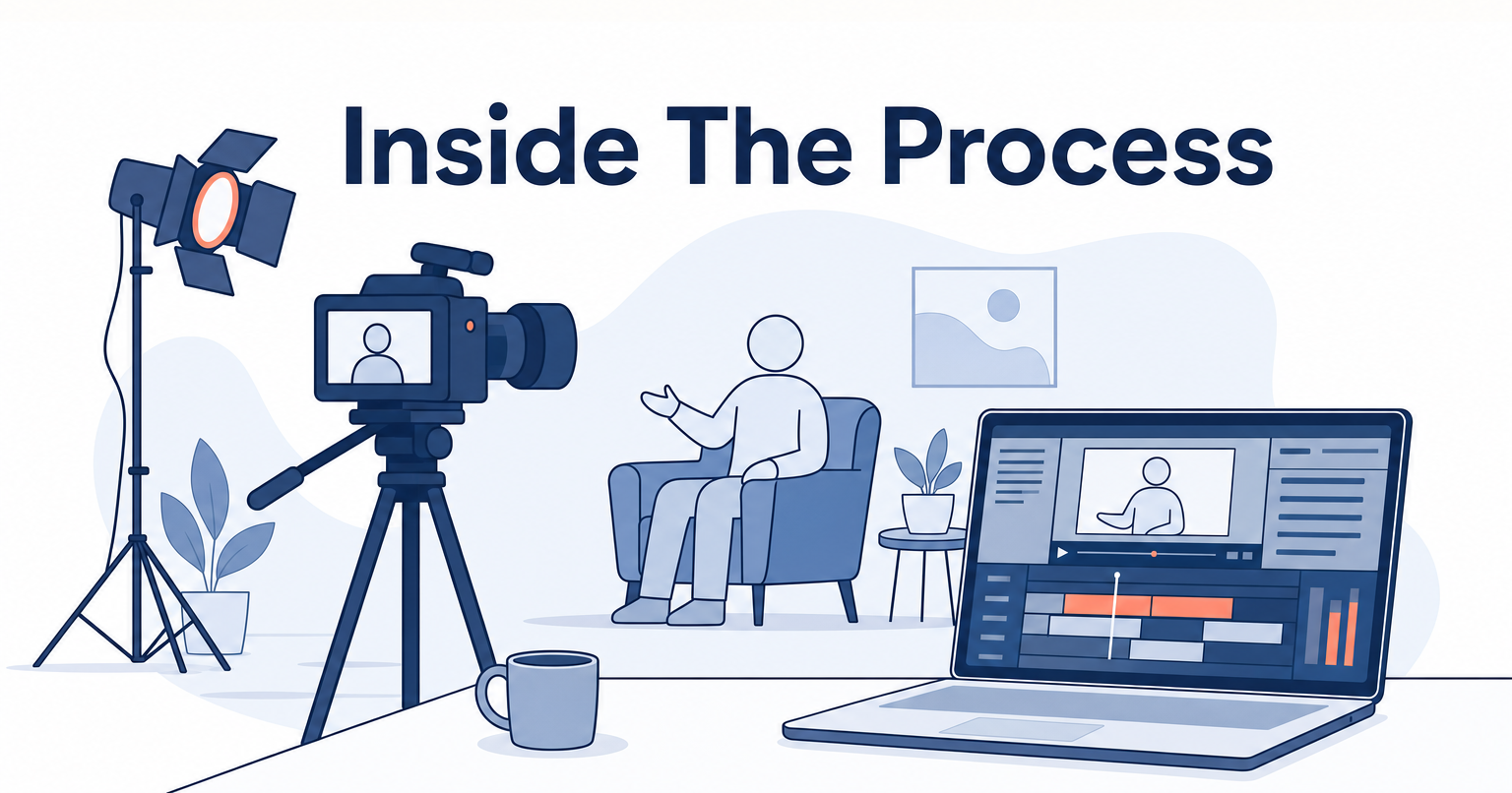
Hiring a video agency for the first time runs through six phases: discovery, creative direction, pre-production, the shoot, post-production, and revisions. For a single B2B or SaaS video, expect four to eight weeks from kickoff to final file, with roughly one day of that spent filming. Most of the calendar is spent on decisions and approvals, not cameras. And a surprising share of it is spent waiting on you.
That last part is the piece nobody warns first-time buyers about, so we will get to it. First, here is what each phase actually is.
Before Phase 1: scope and a number
Nothing on the timeline starts until the scope is written down. What is the deliverable, how many versions of it, how many shoot days, how many people on camera, how many revision rounds, and where the video is allowed to run. Get that in writing. Almost every ugly surprise in a first video project traces back to something that was assumed instead of scoped: a second location, a fourth executive, a paid-media cutdown nobody quoted.
Ask what a change order costs before you need one.
Phase 1: Discovery (the call where you decide what the video is for)
Discovery is a working session, not a sales call. A good agency is trying to answer one question: what single job is this video doing? Homepage explainer, sales-call follow-up, launch trailer, recruiting film, conference booth loop. Each one gets a different structure.
For SaaS work, this is also where the feature mapping happens. We gather everything first: every key feature, then the specific pain each one removes and the outcome it delivers. Then we narrow to three. Clients push back on that almost every time, and the answer is always the same. If you tell them everything, they remember nothing. If everything is exciting, nothing is exciting.
What you bring: your ICP, the objections your sales team hears, and honesty about what has not worked before.
Phase 2: Creative direction (script or interview questions)
If the video is scripted, you get a script. If it is interview-driven (testimonials, brand films, founder stories), you get a question set instead, because you cannot script a real human.
Either way, the structure comes from a story framework. We lean on Donald Miller's StoryBrand: the viewer is the hero with a problem, your brand is the guide with a plan. In practice that means the video opens on a pain or desire in the first few seconds, not on someone saying their name and title. Then it names the brand and immediately positions it: who you help, what you are qualified to do, what outcome you deliver.
Approve this phase carefully. Changing the story after the shoot means reshooting. Changing it now costs one email.
Phase 3: Pre-production (the boring phase that saves the project)
Pre-production is logistics, and it is where an experienced crew earns its rate. Shoot dates and a call sheet with arrival times. Locations, scouted for light and for noise, because a beautiful glass conference room next to an HVAC return is unusable audio. A shot list. Wardrobe guidance, which mostly means no tight patterns and no logos you do not own. Confirmed on-camera talent. And the assets the editor will need later: vector logo files, brand fonts and hex codes, clean product UI recordings, any existing footage worth reusing.
Screen recordings are the one clients forget. If your product is the star, someone on your side has to capture it at full resolution with dummy data that does not leak a real customer name, and that takes longer than anyone expects.
What you bring: confirmed people. The single most common delay is an executive whose calendar moves twice.
Phase 4: The shoot
A typical single-day shoot for a testimonial or explainer runs six to ten hours on site. Crew arrives early to light and set up. Interviews take 30 to 60 minutes per person, and you should expect the good stuff to come from the fourth or fifth answer, not the first. Then b-roll: the supporting footage of offices, hands, screens, faces that gets layered under the dialogue.
Your only job on shoot day is to keep the schedule intact and let the crew work. Resist the urge to coach your own executive between takes. It makes people stiffer, not better.
Phase 5: Post-production (where the video is actually made)
This is the longest phase and the one clients understand least. It goes in this order:
- Paper edit. The editor reads every transcript and pulls the strongest soundbites, then trims each one to its tightest form and sequences them into a story. This is where a video is won or lost. We once took footage another agency had already cut and, using nothing but different soundbite selection, sequencing, and pacing, turned it into the client's most impactful testimonial. Same footage. Different decisions. We break the method down in our guide to sequencing interview soundbites.
- Rough cut. Story assembled, visuals dropped in, no polish yet. Judge structure here, not color or music.
- Movie-trailer edit. We map the turns of the story, then trim, extend, and rearrange the music so the song's turns land on the story's turns. We also build impact moments. Strip the music under a powerful line, add a reverb tail, run a riser into the silence, then bring the track back hard as the line ends. It works like a punctuation mark, and viewers feel it without being able to name it.
- Finishing. Color, sound mix, motion graphics, captions.
Phase 6: Revisions and delivery
Two rounds is standard. Round one addresses structure and content. Round two is polish. Feedback should arrive consolidated, timecoded, and from one decision-maker. Ten stakeholders each sending separate notes is how a two-week post schedule becomes six.
Then comes picture lock, which means the edit is frozen, followed by delivery. Ask up front what lands in the folder. For most projects it should be a high-bitrate master, a compressed web version, a 9:16 vertical cut, burned-in and separate caption files, and the cutdowns you scoped: a 15 or 30 second version pulled from the same master for paid media.
The part first-timers underestimate: you are on the timeline too
Our founder, Mitch McClure, said this about hiring a vendor for Full Send's own website build: "I would guess at least three and a half weeks of that was you waiting on me to get you content." Four to five weeks total. Three and a half of them were his.
Video works the same way. Slow approvals, missing brand assets, and scattered feedback are the reason projects slip, far more often than production problems. Name one internal owner, block their calendar for review days before the project starts, and the four-week version of this schedule is realistic. Skip that and you get the eight-week version.
If you want to see what comes out the other end of this process, our work is the shortest version of the answer. And before you sign with anyone, it is worth knowing which questions reveal whether an agency can actually tell a story.